
Bill C-34’s proposed social media ban for kids has rightly attracted considerable criticism since the bill was tabled last month, given that it requires age verification for most Canadians to use social media and the government plans to implement it before privacy safeguards are in place. Moreover, as I wrote last week, mounting data from Australia indicates that bans simply do not work. Thanks to a reader for pointing to a new Australian study that identifies yet another cost: young people’s access to news. The concern has resonance in Canada, where youth access to news on social media has already been undermined by the Online News Act, which prompted Meta to block news links on Facebook and Instagram. Bill C-34 would exacerbate the problem by cutting kids off TikTok and YouTube, which emerged as important news sources after the Meta news link block.
Post Tagged with: "News"

The Law Bytes Podcast, Episode 209: Peter Menzies on Why the Canadian News Sector is Broken and How to Fix It
It isn’t news that the Canadian news sector is broken: the Online News Act has caused more harm the good, the dependence on government funding and regulation has grown dramatically and undermined public trust, and implementing Bill C-18 has become mired in controversy. Peter Menzies spent three decades as a working journalist and newspaper executive, most notably with the Calgary Herald where he served as its editorial page editor, editor in chief and, finally, publisher. He then spent another 10 years at the CRTC, including four as Vice Chair of Telecommunications. Peter been one of the most prominent voices on the state of the news sector in Canada and he joins the Law Bytes podcast to discuss recent developments alongside proposed reforms that might do a better job of addressing mounting concerns over the independence of the press.
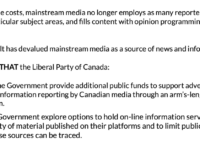
Liberal Party Policy Proposal Would Limit Online Publication to Material “Whose Sources Can Be Traced”
The Liberal Party policy convention is underway in Ottawa with delegates preparing to debate a series of policy proposals that could ultimately make their way into their national election platforms. Party members voted on the top 20 proposals for discussion and included one involving the media and online information that seems obviously unconstitutional and a direct threat to a freedom of the press. The proposal, purportedly aimed at addressing misinformation, calls for more government funding for the media and that the government explore options to “hold on-line information services accountable for the veracity of material published on their platforms and to limit publication only to material whose sources can be traced.”

Just How Extreme is Bill C-18?: It Mandates Payments For Merely Facilitating Access to News
Bill C-18, the Online News Act, is less than 48 hours old, but the more you examine the bill, the worse it gets. My previous posts unpacked why the general policy is bad for press independence and competition as well as why the bill features a misguided attempt to require payments for links. Yet the bill requires an even deeper look since it goes far beyond “compensating journalists when they use their content” (as Prime Minister Justin Trudeau said yesterday in the House of Commons) or even linking to news articles. Rather, the bill requires compensation for facilitating access to news in any way and in any amount.
In doing so, it eviscerates the claim that there is a tangible connection between the requirement to pay for the value of news articles on social media and search platforms (called digital news intermediaries or DNI’s in the bill). Rather, Bill C-18 is a shakedown with requirements to pay for nothing more than listing Canadian media organizations with hyperlinks in a search index, social media post, or possibly even a tweet. At a time when we need the public to access to credible news, Canadian Heritage Minister Pablo Rodriguez believes that large Internet companies that engage in the act of facilitating access to news – not copying, not using, not even directly linking – should pay for doing so.

The Law Bytes Podcast, Episode 92: A Conversation with Senator Paula Simons on Copyright, the Internet and the Future of Media in Canada
Earlier this year, Senator Claude Carignan introduced Bill S-225, a bill that purports to address concerns about the viability of the Canadian media sector by amending the Copyright Act. The Senate has been studying the bill in recent weeks with Senator Paula Simons serving as the bill critic and one of the leads on the issue. Senator Simons was a longtime journalist before being appointed to the Senate and while an ardent supporter of local journalism, she has been critical of the proposed legislation. She joins the Law Bytes podcast to discuss the state of journalism in Canada, why she doesn’t think the social media companies “stole” stories from the media, and what Canada should be doing to encourage innovation in the media sector.

Recent Posts
 “Position Has Not Changed”: The Canadian Government Reaffirms That Antisemitism Includes Anti-Zionism
  The Law Bytes Podcast, Episode 279: My Keynote on Digital Sovereignty: Control, Choice, and Connection
  The What, Me Worry? Consultation: Media Quietly Tells Government It Wants Even More Funding With Little Concern for Independence Risks
  Years of Uncertainty: Bill C-22’s Missing Regulations and Secret Ministerial Orders
  The Missing Charter Statement: Why Hasn’t the Government Explained How Bill C-34’s Social Media Ban Complies with the Charter?
