
The government’s consultation on AI transparency closed yesterday. My submission builds on appearances before the House of Commons Industry committee, the Senate Transport and Communications committee, and the Senate Social Affairs committee, and recommends an AI Transparency Act built on three pillars: mandatory public disclosure of AI corporate safety and escalation policies, an issue I raised in the aftermath of Tumbler Ridge, transparency on the works included in AI training data, and annual transparency reports on government and law enforcement demands for user data. It addresses each of the discussion paper’s five areas, including why Bill C-36 (the government’s privacy reform bill) is unlikely to facilitate better transparency in automated decision-making before at least 2030 and why Bill C-34’s synthetic content labelling obligation does not fully address the issue of identifying such content that can mislead. The full submission is posted below.
Post Tagged with: "transparency"
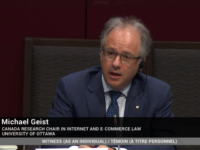
Addressing the AI Policy Challenge: My Appearance before the Standing Senate Committee on Transport and Communications
Earlier this week, I appeared before the Standing Senate Committee on Transport and Communications as part of its study on AI regulation. This follows earlier appearances before the House of Commons Heritage and Industry committees on the same issue. The hearing led to robust exchanges with multiple Senators on the intersection of AI policy with issues such as privacy, copyright, online harms, and sovereignty. I plan to post clips from the hearing in a future Law Bytes podcast, but in the meantime, my opening statement provides a good sense of my views on AI regulation with respect to privacy, copyright, and the need for an AI Transparency Act. A video of the opening statement is embedded below, followed by the text.

Lawful Access on Steroids: Why Bill C-2’s Big Brother Tactics Combine Expansive Warrantless Disclosure with Unprecedented Secrecy
Earlier this week, I wrote about how the government’s inclusion of warrantless information demand powers in Bill C-2 may make this the most dangerous lawful access proposal yet, exceeding even the 2010 bill led by Conservative Public Safety Minister Vic Toews. The post emphasized the broad scope of the information demand power. Unlike prior lawful access proposals that targeted telecom and Internet companies, Bill C-2 targets anyone that provides a service to the public. This could include physicians, lawyers, accountants, financial institutions, hotels, car rental companies, libraries, and educational institutions. The list literally never ends. Each of these service providers could be compelled to confirm whether they have provided services to any subscriber, client, account, or identifier. They must also disclose whether they have any information about the subscriber, client, account or identifier as well as advise where and when they provided the service. On top of that, they must advise when they started providing the service and list the names of any other person that may have provided other services. All without a warrant or court oversight.
Department of Justice officials provided a briefing on the provisions yesterday and confirmed this reading of the bill. Officials acknowledged that Bill C-2 extends far beyond just telecom companies to services such as financial institutions, car rental companies, and hotels. When asked about hospitals, physicians, and other health professionals, the officials affirmed that they were covered as well (officials claimed that there would still be the need for a criminal investigation, but that is incorrect since this applies to any Act of Parliament, not just the Criminal Code).

Why Telecom Transparency Reporting in Canada Still Falls Short
Canadian telecom company privacy practices were back in the spotlight this month with the release of a transparency report from Rogers Communications. The report provides new insights into how much – or how little – Canadians know about when their personal information is disclosed to government agencies.
For Rogers customers, the good news is that recent changes in the law, including court decisions that set limits on the disclosure of mass data from cellphone towers and that protect Internet subscriber information – are having a significant effect. Law enforcement agencies are still able to obtain data on hundreds of thousands of people, but warrantless access to basic subscriber information has stopped.
My weekly technology law column (Toronto Star version, homepage version) notes that the latest Rogers report is the first from the company since the release in 2015 of telecom transparency guidelines that garnered support from the federal privacy commissioner, Industry Canada, and the telecom sector. The guidelines attempt to provide a common framework for disclosure so that the public will be better able to compare privacy protections and policies among Canada’s major telecom companies.

Why the New Canadian Telecom Transparency Rules Fall Short
Canadians have become increasingly troubled by reports revealing that telecom and Internet companies receive millions of requests for subscriber data from a wide range of government departments. In light of public concern, some Internet and telecom companies have begun to issue regular transparency reports that feature aggregate data on the number of requests they receive and the disclosures they make.
The transparency reports from companies such as Rogers, Telus, and TekSavvy have helped shed light on government demands for information and on corporate disclosure practices. However, they also paint an incomplete picture since companies have offered up inconsistent data and some of the largest, including Bell, have thus far refused to come clean on past requests and disclosures.

Recent Posts
 The Wrong Ban: The Heritage Committee Backed a Targeted Ad Ban for Kids and Stopped Short of a Social Media Ban, Yet the Government Chose the Reverse
  Regulator First, Rules Later: Bill C-34 Debate Shows the Government Wants a Digital Safety Commission Before It Figures Out What It Will Do
  Making the Case Against Its Own Bill: What the Government’s Bill C-34 Charter Statement Reveals About the Constitutional Vulnerability of the Social Media Ban
  “Position Has Not Changed”: The Canadian Government Reaffirms That Antisemitism Includes Anti-Zionism
  The Law Bytes Podcast, Episode 279: My Keynote on Digital Sovereignty: Control, Choice, and Connection
