In December 2017, the government launched its copyright review with a Parliamentary motion to send the review to the Standing Committee on Industry, Science and Technology. After months of study and hundreds of witnesses and briefs, the committee released the authoritative review with 36 recommendations that include expanding fair dealing, a rejection of a site blocking system, and a rejection of proposals to exclude education from fair dealing where a licence is otherwise available. The report represents a near-total repudiation of the one-sided Canadian Heritage report that was tasked with studying remuneration models to assist the actual copyright review. While virtually all stakeholders will find aspects they agree or disagree with, that is the hallmark of a more balanced approach to copyright reform.
Post Tagged with: "usmca"

Canada Introduces USMCA Implementation Bill…Without a General Copyright Term Extension Provision
The Canadian government tabled Bill C-100 yesterday, the bill to implement the Canada-US-Mexico Trade Agreement. I will have future post on the key provisions, which include new criminal provisions on trade secrets and tampering with rights management information. The bill also features several provisions related to copyright term but notably does not touch the current general copyright term of life of the author plus an additional 50 years. There are several new terms included in the bill with extensions for anonymous works, performances in sound recordings, sound recordings, and cinematographic works. The bill expressly states that none of the extensions are retroactive which means that the works that are currently in the public domain will remain there even after the new terms are established.

The LawBytes Podcast, Episode 4: Going Inside Canada’s Copyright Review
The House of Commons Standing Committee on Industry, Science and Technology has spent the past year reviewing the state of Canadian copyright law. The review, which is scheduled to result in a report with recommendations for potential reforms, featured hundreds of witnesses representing a wide range of views. To introduce some of the issues and provide some insight into how the review process functions, this week’s LawBytes podcast relies on the audio recording of my committee appearance in December 2018. It opens with my seven minute opening statement and continues with several exchanges with MPs on issues such as fair use, the USMCA, crown copyright, and anti-circumvention rules, which are often referred to as digital locks.
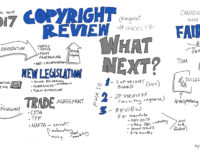
The State of Canadian Copyright: My Copyright Review Appearance Before the Industry Committee
With the Industry committee’s copyright review winding down, I appeared yesterday before the committee to discuss the state of Canadian copyright. The wide ranging two hour discussion focused on everything from fair dealing to crown copyright to concerns that publishers don’t fairly compensate authors for their digital licensing revenues. My opening statement placed the spotlight on five issues: educational copying, site blocking, the so-called value gap, the impact of the copyright provisions of the CUSMA, and potential reforms in support of Canada’s innovation strategy. An audio version and transcript of the opening statement is posted below.

The Full “Culture Exception” That Isn’t: Why Canada Caved on Independent Cultural Policy in the USMCA
In the final weeks of the USMCA negotiations, Canada signalled that a full cultural exception was a non-negotiable issue with Prime Minister Justin Trudeau wading in to emphasize the importance of the issue. While the resulting deal has garnered applause from many culture lobby groups (music, magazines, publishers, ACTRA), the reality is that the government did not obtain a full cultural exception. In fact, after criticizing the Conservatives for accepting exceptions to the cultural exception in the TPP (and making it a key issue in the CPTPP once the U.S. exited the agreement), the Liberal government similarly included two exceptions and agreed to an extension in the term of copyright that will have a far more damaging impact on access to Canadian culture than any proposed USMCA provision.

Recent Posts
 The What, Me Worry? Consultation: Media Quietly Tells Government It Wants Even More Funding With Little Concern for Independence Risks
  Years of Uncertainty: Bill C-22’s Missing Regulations and Secret Ministerial Orders
  The Missing Charter Statement: Why Hasn’t the Government Explained How Bill C-34’s Social Media Ban Complies with the Charter?
  Three Years After October 7th: Living With the Shockwaves
  What If the U.S. Demanded This? The Cloud Provider Conditions Behind Canada’s EU Digital Pivot
