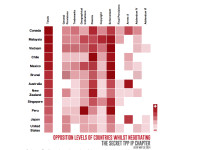

Cooperation in the Pacific Rim by Jakob Polacsek, World Economic Forum (CC BY-NC-SA 2.0) https://www.flickr.com/photos/worldeconomicforum/48179628441

Cooperation in the Pacific Rim by Jakob Polacsek, World Economic Forum (CC BY-NC-SA 2.0) https://www.flickr.com/photos/worldeconomicforum/48179628441

Digital Trade

europe infinite copyright by Jose Mesa (CC BY 2.0) https://flic.kr/p/amMHBV

How Canada Shaped the Copyright Rules in the EU Trade Deal

In late December 2009, Wikileaks, the website that publishes secret government information, posted a copy of the draft intellectual property chapter of the Canada – European Trade Agreement (CETA). The CETA deal was still years from completion, but the leaked document revealed that the European Union envisioned using the agreement to mandate a massive overhaul of Canadian law.

The leak generated concern among many copyright watchers, but when a German television station leaked the final text of the agreement last week, it contained rules that largely reflect a “made-in-Canada” approach. Why the near-complete reversal in approach on one of the most contentious aspects of a 500 page treaty?

My weekly technology law column (Toronto Star version, homepage version) notes the starting point for copyright in CETA as reflected in 2009 leaked document was typical of European demands in its trade agreements. It wanted Canada to extend the term of copyright to life of the author plus 70 years (Canada is currently at the international standard of life plus 50 years), adopt tough new rules for Internet provider liability, create criminal sanctions for some copyright infringement, implement new rights for broadcasters and visual artists, introduce strict digital lock rules with minimal exceptions, and beef up enforcement powers. In other words, it was looking for Canada to mirror its approach on copyright.

Read more ›

August 21, 2014 7 comments Columns
PM Harper visits Brussels to conclude Canada-EU Trade Negotiations by Stephen Harper (CC BY-NC-ND 2.0) https://flic.kr/p/gLRSYL

Did Canada Cave on the Pharmaceutical Patent ISDS Issue in CETA?: Still No Text, But Official Comments Suggests It Did

For the second time in less than a year, Canada and the EU have announced that they reached agreement on the Canada – EU Trade Agreement.  Back in October 2013, there was an announcement of an agreement “in principle”.  The announcement did not include a release of the text and the parties said there was still further work to be done on drafting and legal analysis. Yesterday, brought another announcement of an agreement on the text. Once again, the announcement did not include a release of the text and the parties said there was still further work to be done on legal review and translation into 23 languages.

Given the agreement is 1,500 pages, the additional work is expected to take a considerable amount of time. While government ministers claimed that CETA “is ready for debate and ratification”, the reality is that there cannot be a meaningful, informed debate without the actual text. Releasing it for full study and comment is the essential next step.

Analysis without the text is difficult, however, the combination of prior leaks and media reports indicate that Canada caved on its concerns regarding the potential replication of Eli Lilly-style pharmaceutical patent lawsuits.

Read more ›

August 6, 2014 4 comments News
Patents are only for the old machine by Alexandre Dulaunoy (CC BY-SA 2.0) https://flic.kr/p/zw2KV

How a 20 Year Old Patent Application Could Up-End Canada’s Biggest Trade Deal

In the early 1990s, pharmaceutical giant Eli Lilly applied for patent protection in Canada for two chemical compounds, olanzapine and atomoxetine. The company had already obtained patents over the compounds, but asserted that it had evidence to support new uses for the compounds that merited further protection. The Canadian patent office granted the patents based on the content in the applications, but they remained subject to challenge.

Both patents ultimately were challenged on the grounds that there was insufficient evidence at the time of the applications to support the company’s claims. The Federal Court of Canada agreed, invalidating both patents. Eli Lilly proceeded to appeal the decision to the Federal Court of Appeal and later to the Supreme Court of Canada. The company lost the appeals, as the courts upheld the decision to invalidate the patents.

My weekly technology law column (Toronto Star version, homepage version) notes that under most circumstances, that would conclude the legal story as nine Canadian judges reviewed Eli Lilly’s patent applications and ruled that they failed to meet the standards for patentability. Yet in June 2013, the company served notice that it planned to file a complaint under the North American Free Trade Agreement claiming that in light of the decisions, Canada is not compliant with its patent law obligations under the treaty. As compensation, Eli Lilly is now seeking $500 million in damages.

Read more ›

August 5, 2014 17 comments Columns
comcast_six_strikes_alert by aaron_anderer (CC BY-ND 2.0) https://flic.kr/p/dYokuc

Notice the Difference: Canada’s Internet Provider Notice-and-Notice Rules and the TPP

Last week, negotiators from around the world gathered in Ottawa for negotiations on the Trans Pacific Partnership agreement. I was fortunate to be asked to meet with many of the intellectual property negotiators as part of a side session sponsored by the Electronic Frontier Foundation on the copyright implications of the agreement.  EFF’s Jeremy Malcolm and Maira Sutton write about the event here, which also included Howard Knopf and Open Media’s Reilly Yeo.

My presentation
, embedded below, focused on the Canadian notice-and-notice rules for Internet service provider liability. The government recently announced that notice-and-notice will take effect in January 2015. I explained the background of the Canadian approach, how it differs from the U.S. notice-and-takedown system, and how experience demonstrates its effectiveness.

Read more ›

July 18, 2014 2 comments News
Cross Border Action: The People's Round on the Trans Pacific Partnership by Caelie_Frampton (CC BY-NC-SA 2.0) https://flic.kr/p/dy8srf

Why The Secrecy on the TPP Talks in Ottawa This Week? Because There is Something to Hide

Trade agreements have emerged in recent years as one of the federal government’s most frequently touted accomplishments. Having concluded (or nearly concluded) free trade deals with the likes of the European Union and South Korea, senior government ministers such as International Trade Minister Ed Fast and Industry Minister James Moore have held dozens of events and press conferences across the country promoting the trade agenda.

The next major agreement on the government’s docket is the Trans Pacific Partnership, a massive proposed trade deal that includes the United States, Australia, Mexico, Malaysia, Singapore, New Zealand, Vietnam, Japan, Peru, and Chile. While other trade talks occupy a prominent place in the government’s promotional plans, the TPP remains largely hidden from view. Indeed, most Canadians would be surprised to learn that Canada is hosting the latest round of TPP negotiations this week in Ottawa.

My weekly technology law column (Toronto Star version, homepage version) argues the secrecy associated with the TPP – the draft text of the treaty has still not been formally released, the precise location of the Ottawa negotiations has not been disclosed, and even the existence of talks was only confirmed after media leaks – suggests that the Canadian government has something to hide when it comes to the TPP.

Read more ›

July 7, 2014 17 comments Columns