Appeared in the Toronto Star on May 18, 2013 as It’s Time to Admit the Copyright Board is Broken With the latest phase of Canadian copyright reform now complete, the government may soon turn to the question of what comes next. Given last year’s major legislative overhaul and the landmark […]

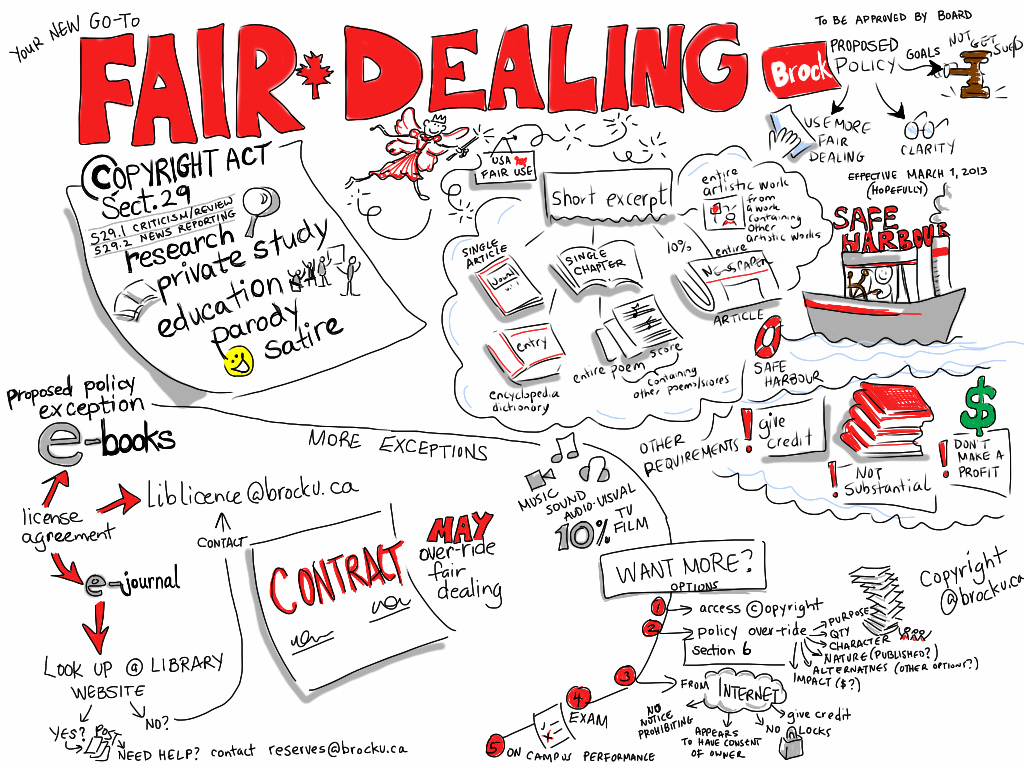
Fair Dealing by Giulia Forsythe (CC BY-NC-SA 2.0) https://flic.kr/p/dRkXwP
Copyright
The Copyright Pentalogy: Technological Neutrality
Last month, the University of Ottawa Press published The Copyright Pentalogy: How the Supreme Court of Canada Shook the Foundations of Canadian Copyright Law, an effort by many of Canada’s leading copyright scholars to begin the process of examining the long-term implications of the copyright pentalogy. As I’ve noted in previous posts, the book is available for purchase and is also available as a free download under a Creative Commons licence. The book can be downloaded in its entirety or each of the 14 chapters can be downloaded individually.
The book includes two articles on technological neutrality, whose inclusion as a foundational principle of Canadian copyright was a landmark aspect of the copyright pentalogy. The message from the Court is clear: copyright law should not stand in the way of technological progress and potentially impede the opportunities for greater access afforded by the Internet through the imposition of additional fees or restrictive rules that create extra user costs. Viewed in this light, technological neutrality as a principle within Canadian copyright may have the same dramatic effects on the law as the articulation of users’ rights did in 2004.
Copyright Board of Canada Admits to “Palpable Error” in Music Tariff Decision
The Copyright Board of Canada has released a decision in which it admits to palpable error that resulted in a hugely inflated tariff. The case involved a tariff for SODRAC for reproduction of music works in cinematographic works for private use of for theatrical exhibition. The Canadian Association of Film […]
Access Copyright’s Desperate Declaration of War Against Fair Dealing
Months after the Supreme Court of Canada delivered a stinging defeat to Access Copyright by ruling for an expansive approach to fair dealing and the government passed copyright reforms that further expanded the scope of fair dealing, the copyright collective responded yesterday with what amounts to a desperate declaration of war against fair dealing. In the aftermath of the court decisions and legislative reforms, a consensus emerged within the Canadian education community on the scope of fair dealing. The fair dealing policies used guidance from the Supreme Court to establish clear limits on copying and eliminate claims that the law was now a free-for-all. In developing those fair dealing policies, however, many institutions no longer saw much value in the Access Copyright licence.
Access Copyright has decided to fight the law – along with governments, educational institutions, teachers, librarians, and taxpayers – on several fronts. It has filed for an interim tariff with the Copyright Board in an effort to stop K-12 schools from opting out of its licence and it has filed a proposed post-secondary tariff that would run well after most Canadian schools will have opted out of its licence. Most notably, it has filed a lawsuit against York University over its fair dealing guidelines, which are similar to those adopted by educational institutions across the country. While the lawsuit has yet to be posted online [Update: Statement of Claim posted here], the Access Copyright release suggests that the suit is not alleging specific instances of infringement, but rather takes issue with guidelines it says are “arbitrary and unsupported” and that “authorize and encourage copying that is not supported by the law.”
Most of Access Copyright’s longstanding arguments were dismissed by the Supreme Court this past summer.
European Commission Study Finds Online Music Piracy Doesn’t Hurt Sales
The European Commission’s Joint Research Centre has released a report that finds that online music piracy does not harm sales. The report examined the browsing habits of more than 16,000 European consumers. It found that an increase in clicks on infringing sites led to a small increase in clicks on […]