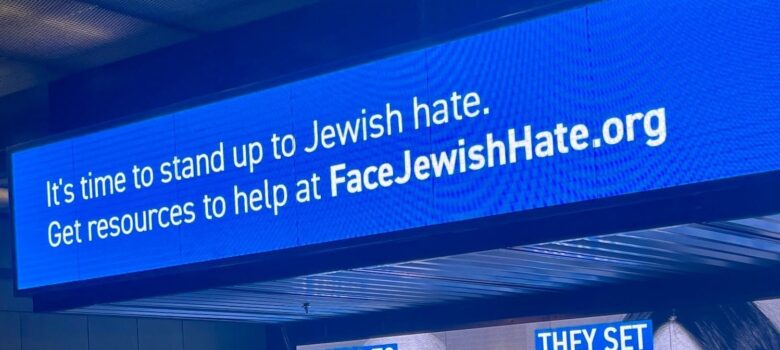
Earlier this month, I appeared on CBC’s The Current to discuss the escalation of antisemitic violence in Canada following my Globe op-ed and PROC committee appearance. The host asked me whether something like the Bondi Beach massacre, the December 2025 attack that killed 15 people at a Hanukkah celebration in Australia, could happen here. I replied that it was a certainty. He was taken aback and pressed me on it. I clarified that I didn’t mean a massacre was certain, but that with the relentless escalation of antisemitic violence in Canada, people would die. It was not a matter of if, but when.
That exchange has stayed with me, not because I said something provocative, but because his surprise was so revealing. What felt to me (and I believe many in the Jewish community) like an obvious, even understated observation given the inevitable endpoint of a trajectory visible to anyone who has been paying attention, registered to him as an alarming claim requiring justification. That gap between what the Jewish community experiences and what everyone else appears willing to acknowledge has been a defining feature of the post-October 7th world.
And yet, in recent days there is a hint of a shift. This weekend Toronto Police banned protests on residential streets near Bathurst and Sheppard, the intersection at the heart of Toronto’s Jewish community where weekly demonstrations have been held for more than two years. Deputy Chief Frank Barredo said protesters can still gather on the main roads but will face arrest if they enter residential streets. Soon after, Chief Myron Demkiw announced the creation of a dedicated Counter-Terrorism Security Unit and a new Task Force Guardian that will deploy officers with tactical gear and patrol rifles at places of worship, tourist hubs, and community centres across the city. The RCMP, OPP, and CSIS are all part of the coordinated response.
There is far more to be done to remedy years of inaction, but these are welcome measures. They are also measures that should provoke a deeply uncomfortable question: if this was always possible, why didn’t it happen sooner?
Alongside many others (see Jesse Brown’s polite pogrom piece), I have been writing about these issues for some time. Last November, I argued in the Globe and Mail that freedom of expression must not become a right to harass or intimidate, after watching masked protesters march through the same residential streets where my grandfather once took daily walks. The police response at the time was to trail behind on bicycles. Before that, I raised concerns about the situation on university campuses in 2024, when the alarm bells from faculty and students were met with disbelief. Last fall, I wrote about the inadequacy of political responses in the aftermath of the stabbing of an elderly Jewish lady near my home.
Throughout it all, the response followed a depressingly familiar pattern. Politicians issued carefully worded statements opposing “all forms of hate.” The Ontario Solicitor General wrote a letter urging the Toronto Police to do more. The Police Association said leadership wasn’t giving officers clear direction. Everyone pointed fingers. Week after week, the antisemitic incidents escalated, and the fears on campus, in synagogues, and in community centres grew.
The community was told the authorities were doing what they could. But were they? These announcements make clear they could have done far more. If restricting protests from residential streets is now characterized as a reasonable limitation on Charter rights, it was a reasonable limitation six months ago. If a counter-terrorism unit is appropriate today, the conditions that justify it didn’t materialize overnight. A police presence has been constant outside of Jewish community centres, schools, and synagogues for years given the unimaginably long list of institutions that have been the targets of shootings, firebombs or vandalism.
What changed is not the threat. What changed is that the threat has become impossible to ignore. Three Toronto synagogues were shot at in a single week in early March. Then the U.S. consulate in Toronto was shot at. Then came protesters parading signs with imagery out of 1930s Nazi propaganda depicting Jews as rats and gaunt monsters. And an Integrated Threat Assessment Centre report warning that a “lone actor” attack on Jewish Canadians is a “realistic possibility” in the coming months.
For two-and-a-half years, the Jewish community has been sounding the alarm. And we have been met, at best, with sympathetic nods and assurances that the authorities are doing all they can. At worst, we have been told we are overreacting, have no right to feel safe, and that we are conflating criticism of Israel with antisemitism. Go on social media and you will see these messages today. But perhaps the reality is breaking through. It should not have taken bullets in synagogue doors since the warning signs were always there. The tools such as bubble zone bylaws, hate speech provisions, and the Criminal Code, were always there. What has been missing is the will to act.







I agree with everything you have said but I feel that addressing the threat by increasing security is only a half measure. The threat to Jews is endemic throughout society and its institutions. The only way to make canada a home for Jews is to marginalize or eliminate the threat. Our governments have no appetite to do this due to voting patterns and fear of being called out for Islamophobia.