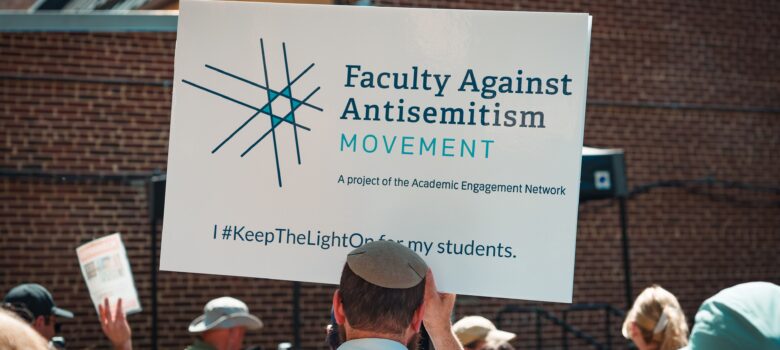
Over the past several weeks, I have written and spoken about the escalation of antisemitic violence in Canada including a Globe and Mail op-ed, a blog post after Toronto Police finally moved to restrict protests from Jewish residential streets, an interview on CBC’s The Current, and a PROC committee appearance where antisemitism was raised. In each case, I shared the piece or clip on social media (here, here, here), sparking a torrent of antisemitic vitriol that even after months of escalation leaves me stunned. I write this post not to amplify the vocal hate that fills my timeline, but to ensure that readers who might otherwise not scroll past my original posts understand what has become normalized.
Since October 7th, I have struggled to understand the two ends of the antisemitism spectrum. First, the vocal knee-jerk hate with echoes of centuries-old tropes that paint Jews as the predominant source of evil. And second, the silence on antisemitism from those who should know better including the voices that previously assured us to believe all women, emphasized the harm of micro-aggressions, and were quick to defend vulnerable communities. The voices that would never tolerate hatred directed at any other group have gone quiet or found ways to rationalize what is happening. Both the vocal hate and the silence manifest on social media: the hate fills the replies while the people you would expect to push back are nowhere to be found. The response I get is troubling, but there are others in Canada – Jesse Brown, Adam Louis-Klein, Harley Finkelstein, Robyn Urback, Mark Goldberg, David Jacobs and many more – who face a barrage of hate and criticism that is so wildly disproportionate that it seems to matter little what they actually say.
What follows is a sample of the replies to my last few posts when writing about antisemitism. With one exception that X flagged for violating its hateful conduct rules, every one of these replies appears on the platform like any other post, visible to anyone.
i. Hate
Some replies dispensed with pretence entirely. One called Jews “an odious, self-entitled, self-serving, vexatious tribe” and a “despicable community.” Another, “It’s time to stand up to Jewish supremacy goy lives matter.” One declared “Fuck the Zionist Community” alongside an image depicting a noose. Another warned that “it’s not antisemitic to hate you…there’s special prizes waiting for you fuckers” – an open threat directed at me and, by extension, the community I was writing about. These are not responses to a political argument. They are expressions of hatred toward Jewish people, prompted by nothing more than a Jewish person writing about the safety of Jewish communities.
ii. Denial
Perhaps the most disorienting category was the flat denial that antisemitism exists in Canada. These are posted, without apparent irony, in the same thread about synagogue shootings or the use of Nazi-era imagery. “There is no anti-Jewish attitude anywhere, except by Zionists,” wrote one respondent. “What risks? There is no antisemitism in Canada,” wrote another. A third dismissed the synagogue shootings as “a very obvious op,” asserting with confidence and without evidence that the Jewish community had staged attacks on itself. Yet another added “It’s adorable how you synchronize your scams from Toronto to London.” Others shared links to compilations purporting to document Jews faking hate crimes. What is striking is not the reflexive insistence that antisemitic incidents are fabricated, exaggerated, or self-inflicted, but that it coexists in the same conversation thread with open antisemitic hatred. The people denying antisemitism and the people demonstrating it are replying to the same tweet.
iii. Deflection
The largest category of replies did not engage with the substance of what I wrote. Instead, they changed the subject. I wrote about synagogues in Toronto being shot at; the replies were about Gaza, the IDF, Israeli government policy, and the Middle East conflict. One demanded to know whether I had “condemned the IDF.” Several posted images and statistics about Palestinian casualties. Others shared editorial cartoons about the Israeli military.
This pattern of treating any discussion of antisemitism targeting Canadian Jews as an invitation to litigate the Israeli-Palestinian conflict is itself a form of the problem. Canadian Jews are not the Israeli government. A grandmother stabbed in an Ottawa grocery store has nothing to do with events in Gaza. Synagogues shot at in North York are not military installations. Further, violence such as shootings, stabbings or vandalism is never an acceptable response, no matter the political views. The persistent refusal to engage with antisemitism on its own terms, and the insistence on redirecting every conversation about Jewish safety toward Israeli government actions, reinforces the very conflation that enables the targeting of Jewish communities in the first place.
iv. Right to Expression
Finally, there were the replies that objected not to anything specific I wrote, but to the fact that I wrote it at all. “Never satisfied. Still whining.” “It’s always a different sob story.” “It’s fucking tiring, Michael.” “Shut the fuck up sniveling Heeb.” “Bet you’re happy as a pig that your jew whining has finally broken through.” The message was clear: a Jewish person raising concerns about the safety of Jewish communities is, in itself, a problem.
I share this not to invite sympathy, and not because the hostility is unique to me. Anyone who writes publicly about antisemitism in Canada, whether journalists, academics, or community advocates, will have similar stories to tell. And that is precisely what should concern all Canadians, both for the tolerance of hate and for its chilling effect on freedom of expression.
When a law professor writing in mainstream Canadian outlets about documented acts of violence receives open threats, denial that the violence occurred, and accusations that the Jewish community is fabricating attacks on itself, we are not dealing with a fringe phenomenon. We are looking at an environment in which antisemitic violence is met not with solidarity but with suspicion, not with concern but with the demand to justify why concern is warranted at all.
My piece asked why it took bullets in synagogue doors to prompt action. The reply thread answered the question. It took that long because too many people have decided that antisemitism is either not real, not serious, or not their problem. Until that changes, the gap between what the Jewish community sees and what everyone else is willing to acknowledge will continue to widen. The question I am left with is not why the hate exists. It has always existed. The question is why so many people who know better have decided that this particular hatred is one they can live with.