
News

Top Secret by Vs Heidelberg https://flic.kr/p/pwTrte CC BY-SA 2.0

The Commission: How Bill C-34 Creates an Internet Super-Regulator That Will Touch the Lives of Millions of Canadians

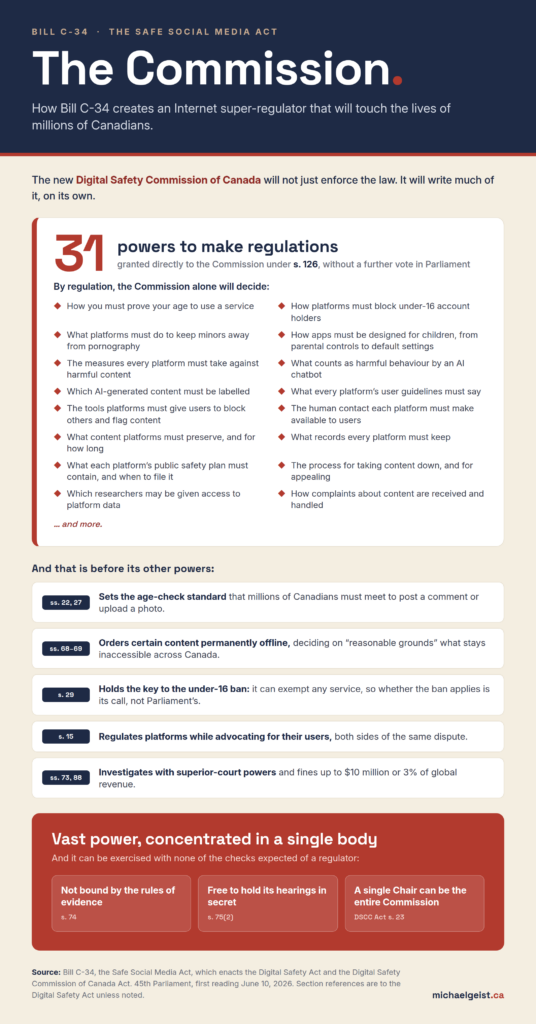
The proposed kids’ social media ban is capturing the headlines, but lost in the debate over Bill C-34 is that its most consequential element may be the creation and powers of the government agency the bill establishes to oversee the entire system. The Digital Safety Commission of Canada will be a super-regulator of the Internet, with greater influence over the daily lives of Canadians than perhaps any other regulator in the country. The breadth of its influence can’t be overstated: it will set the standards that millions of Canadians must satisfy to verify their age in order to use social media services. It will establish what platforms must do about harmful content, including the removal of certain material. It will determine whether the age-gating requirement may be lifted for any given service. It will both regulate the platforms and advocate for their users, dual roles that raise obvious fairness concerns. And it will exercise investigative and adjudicative powers, complete with penalties, hearings, and formal, law-enforcement-style investigations. Yet despite all those powers, it will not be bound by the rules of evidence, will be free to conduct its hearings in secret, and, at least in the beginning, will be capable of operating as a one-person body in which the Commission and its Chair are one and the same individual. The full scope of the new powers is illustrated in the infographic below.

Read more ›

June 15, 2026 6 comments News
Privacy by Andrew Back CC BY-NC-SA 2.0 https://flic.kr/p/4KzgkH

Privacy as a Fundamental Right? The Government’s Terrible Privacy Track Record Suggests Virtue Signalling Over a Genuine Commitment

The government is set to introduce its long-promised privacy reform legislation early this week, with the recognition of a fundamental right to privacy expected to serve as a foundational element of the bill. Establishing privacy as a fundamental right would be a welcome and long-overdue development, one that many have called for and that was set to be added to Bill C-27, the prior attempt at privacy reform. Yet the framing is difficult to square with the government’s actual record on privacy, which over the past year has involved a steady stream of privacy-invasive measures that leave the fundamental rights rhetoric feeling more like virtue signalling than a genuine commitment. Simply put, the government cannot credibly claim to treat privacy as a fundamental right while actively undermining that right through a series of other bills and efforts to sideline the Privacy Commissioner of Canada.

Read more ›

June 14, 2026 3 comments News
Law to Be Named Later, Exemption Illusion

Taking Stock of Bill C-34: Five Things to Know About the Government’s Plan for a Kids’ Social Media Ban, Mandated Age Verification, and AI Chatbot Rules

This past week in digital policy was dominated by Bill C-34, the Safe Social Media Act, which includes platform regulation, an under-16 social media ban backed by mandated age verification, a new AI chatbot regulatory regime, and the creation of a powerful Digital Safety Commission. I have posted daily on the bill, including my initial review, an examination of the 50 key decisions the bill leaves for later, and a closer look at the government’s fast-track implementation plan, alongside a FAQ and posts on mandated ID and trade risks that I published just before the bill was tabled. For those coming to the issue fresh, this post draws on the week’s posts by taking stock of where things stand.

Read more ›

June 13, 2026 3 comments News
No Ban - No Wall - No Raids by ep_jhu https://flic.kr/p/RtQNpo CC BY-NC 2.0

The Exemption Illusion: Why the Government’s Plan to Fast Track Bill C-34’s Kids’ Social Media Ban Means No Standards, No Privacy Review, and No Enforcement

One of the most heavily promoted features of Bill C-34, the government’s Safe Social Media Act, is that its social media ban for those under 16 comes with a potential exemption for platforms that satisfy the new Digital Safety Commission that they provide adequate safeguards for children. But based on comments from government officials, it appears the exemption is an illusion, at least for years to come. The legislation carefully sets out how the ban is supposed to work, but officials at a technical briefing on the bill this week described a very different plan that involves moving quickly after Royal Assent with regulations to bring the ban into force without waiting for the Digital Safety Commission to be fully operational. No Commission means no age verification standards, no privacy review, no exemption, and no effective enforcement. It also creates huge risks since the initial start of the ban is when tens of millions of Canadians would be required to verify their age, yet the government is sidelining the privacy protections written into its own bill and essentially conceding that the ban is unlikely to carry any real consequences for those services that fail to comply when it first takes effect.

Read more ›

June 12, 2026 2 comments News
Sima Acan by BooBoo2517, CC BY-SA 4.0 , via Wikimedia Commons

Liberal MP: Lawful Access “Has Nothing to Do With the Privacy of People and Their Information”

The government is set to introduce privacy reform next week with the “fundamental right to privacy” expected to serve as a foundational element of the forthcoming bill. Yet as the Standing Committee on Public Safety and National Security continues its clause-by-clause review of Bill C-22, Liberal MP Sima Acan last night offered a stunning perspective suggesting that the government simply does not conceive of privacy as most Canadians do. Frustrated with the dogged efforts of Conservative MP Jacob Mantle to address the privacy implications of the bill, Acan stated that the bill “has nothing to do with the privacy of people and their information.” After multiple hearings on the privacy consequences of mandatory metadata retention, backdoor access and weakened encryption, and reduced evidentiary standards for access to subscriber information, the comment is ill-informed and simply shocking. If that position reflects the broader view within the government, it is little wonder that the privacy risks of lawful access have not been taken seriously.

Read more ›

June 12, 2026 2 comments News