
The government’s recently tabled privacy reform bill would modernize many aspects of Canadian privacy law, including establishing privacy as a fundamental right in the purpose clause of the new law, creating a data mobility right for individuals that would enable them to move their data from one company to another, and giving businesses the potential to use approved codes of practice. These and many other changes will be subject to intense debate at committee, but the biggest challenge facing the bill is the long sequence of steps required for it to take effect. The government may claim that privacy is an urgent priority, and its recent national AI strategy, overseen by AI Minister Evan Solomon, declares trust to be its “north star”, yet a careful review of Bill C-36 confirms that the law will take years to take effect. This post and the accompanying infographic unpack the many steps built into the bill that, cumulatively, are likely to result in no substantive privacy reforms for Canadians until 2030 or later.
Post Tagged with: "c-34"

One Step Forward, Two Steps Back: Bill C-36 Modernizes Canada’s Privacy Law, Then Delays It to 2030
Canada’s private sector privacy law is more than 25 years old and there is broad consensus that a modernization is long overdue. Bill C-36, tabled on Monday, is the government’s third attempt at updating the law, following the failed efforts with Bill C-11 in 2020 and Bill C-27 in 2022. My first post on the new bill focused on what I think remains both the most important development and the biggest mistake: the decision to push the Privacy Commissioner of Canada out of private-sector privacy and to place the file with an overloaded digital safety commission. For years, privacy critics have argued that, given the absence of order-making powers or serious penalties, Canada’s biggest shortcoming has been weak enforcement. Yet just as the government adds much-needed new rights and penalties to the privacy law framework, it undermines enforcement once again by introducing a new regulator that will take years to establish. The consequence is that, rather than updating the law for 2027, it is updating it for 2030 or later.

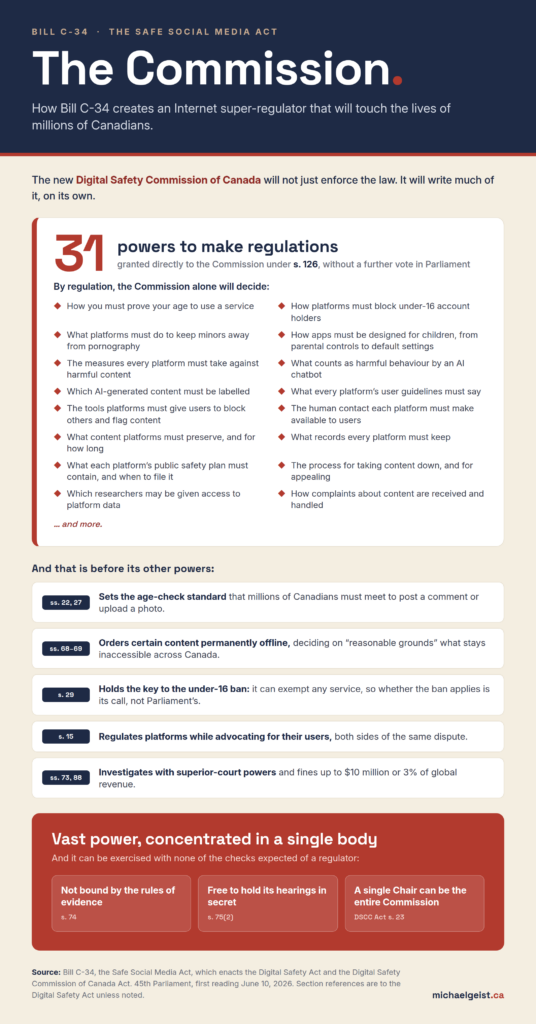
The Commission: How Bill C-34 Creates an Internet Super-Regulator That Will Touch the Lives of Millions of Canadians
The proposed kids’ social media ban is capturing the headlines, but lost in the debate over Bill C-34 is that its most consequential element may be the creation and powers of the government agency the bill establishes to oversee the entire system. The Digital Safety Commission of Canada will be a super-regulator of the Internet, with greater influence over the daily lives of Canadians than perhaps any other regulator in the country. The breadth of its influence can’t be overstated: it will set the standards that millions of Canadians must satisfy to verify their age in order to use social media services. It will establish what platforms must do about harmful content, including the removal of certain material. It will determine whether the age-gating requirement may be lifted for any given service. It will both regulate the platforms and advocate for their users, dual roles that raise obvious fairness concerns. And it will exercise investigative and adjudicative powers, complete with penalties, hearings, and formal, law-enforcement-style investigations. Yet despite all those powers, it will not be bound by the rules of evidence, will be free to conduct its hearings in secret, and, at least in the beginning, will be capable of operating as a one-person body in which the Commission and its Chair are one and the same individual. The full scope of the new powers is illustrated in the infographic below.

Privacy as a Fundamental Right? The Government’s Terrible Privacy Track Record Suggests Virtue Signalling Over a Genuine Commitment
The government is set to introduce its long-promised privacy reform legislation early this week, with the recognition of a fundamental right to privacy expected to serve as a foundational element of the bill. Establishing privacy as a fundamental right would be a welcome and long-overdue development, one that many have called for and that was set to be added to Bill C-27, the prior attempt at privacy reform. Yet the framing is difficult to square with the government’s actual record on privacy, which over the past year has involved a steady stream of privacy-invasive measures that leave the fundamental rights rhetoric feeling more like virtue signalling than a genuine commitment. Simply put, the government cannot credibly claim to treat privacy as a fundamental right while actively undermining that right through a series of other bills and efforts to sideline the Privacy Commissioner of Canada.

Taking Stock of Bill C-34: Five Things to Know About the Government’s Plan for a Kids’ Social Media Ban, Mandated Age Verification, and AI Chatbot Rules
This past week in digital policy was dominated by Bill C-34, the Safe Social Media Act, which includes platform regulation, an under-16 social media ban backed by mandated age verification, a new AI chatbot regulatory regime, and the creation of a powerful Digital Safety Commission. I have posted daily on the bill, including my initial review, an examination of the 50 key decisions the bill leaves for later, and a closer look at the government’s fast-track implementation plan, alongside a FAQ and posts on mandated ID and trade risks that I published just before the bill was tabled. For those coming to the issue fresh, this post draws on the week’s posts by taking stock of where things stand.

Recent Posts
 The Missing Charter Statement: Why Hasn’t the Government Explained How Bill C-34’s Social Media Ban Complies with the Charter?
  Three Years After October 7th: Living With the Shockwaves
  What If the U.S. Demanded This? The Cloud Provider Conditions Behind Canada’s EU Digital Pivot
  Ontario is Done Waiting for Universities to Act on Campus Antisemitism
  Is Compromise on Encryption Possible? Why Bill C-22’s “Minor Opening” Leaves the Central Question Unanswered
