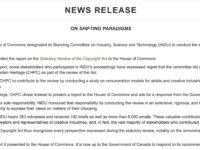
My series on why the Industry committee rightly chose to ignore the Canadian Heritage committee study on artist remuneration took an unexpected turn yesterday. Hours after I posted an analysis demonstrating that the Heritage committee had ignored its mandate by tabling its report in the House of Commons, the Industry committee issued an unprecedented news release confirming that it did not consider the Heritage report and that its report is the exclusive copyright review. The news release states:
Post Tagged with: "indu"

Process Failure: Why the Copyright Review Was Right To Ignore the Canadian Heritage Committee Study, Part One
The release of the much-anticipated copyright review report from the Standing Committee on Industry, Science and Technology has sparked a range of reactions. From UNEQ’s “the committee despises creators” to Canadian Music Publishers Association’s “disappointing“, some groups would clearly prefer that the government pay attention to the one-sided Canadian Heritage study instead. In fact, the report makes it clear that the committee did not read the Heritage study, as the committee thanked its colleagues and noted that it “looks forward to consulting their report.”
That approach angered Heritage committee member Pierre Nantel, who moved a motion that the committee “express its dismay” that its report was ignored. At this stage, it does not appear that the committee will consider Nantel’s motion as no further meetings are planned before the House of Commons breaks for the summer and then dissolves with the fall election.
The LawBytes Podcast, Episode 16: The Copyright Review Report – Carys Craig on the Roadmap for the Future of Canadian Copyright Law
In December 2017, the Canadian government launched its much-anticipated and much-lobbied review of Canadian copyright law, tasking the Standing Committee on Industry, Science and Technology to lead the way. After months of study and hundreds of witnesses and briefs, the committee released its authoritative report with 36 recommendations earlier this month. Carys Craig, a law professor at Osgoode Hall Law School and one of Canada’s leading copyright law experts, joins the podcast to help sort through the report and to consider what it means for the future of Canadian copyright law.

Fixing Fair Dealing for the Digital Age: What Lies Behind the Copyright Review’s Most Important Recommendation
The long-awaited Canadian copyright review report features numerous good recommendations, many of which were rejections of industry lobbying: a rejection of new restrictions on fair dealing for education, rejection of Bell’s FairPlay site blocking initiative, and rejection of limits on safe harbours in response to the so-called “value gap.” Yet the most notable recommendation is the committee’s support for fair dealing for the digital age by expanding its scope and ensuring that it applies equally in the analog and digital worlds.
I wrote about the need to fix fair dealing for the digital age in May 2018:

The Authoritative Canadian Copyright Review: Industry Committee Issues Balanced, Forward-Looking Report on the Future of Canadian Copyright Law
In December 2017, the government launched its copyright review with a Parliamentary motion to send the review to the Standing Committee on Industry, Science and Technology. After months of study and hundreds of witnesses and briefs, the committee released the authoritative review with 36 recommendations that include expanding fair dealing, a rejection of a site blocking system, and a rejection of proposals to exclude education from fair dealing where a licence is otherwise available. The report represents a near-total repudiation of the one-sided Canadian Heritage report that was tasked with studying remuneration models to assist the actual copyright review. While virtually all stakeholders will find aspects they agree or disagree with, that is the hallmark of a more balanced approach to copyright reform.

Recent Posts
 When Writing About Antisemitism Proves the Point: What the Replies Reveal
  Acting on Antisemitism: If This Was Always Possible, Why Didn’t It Happen Sooner?
  Setting Canada’s AI Policy Priorities: My Appearance Before the Standing Committee on Industry, Science and Technology
  The Law Bytes Podcast, Episode 262: Zack Shapiro on the Claude AI Native Law Firm
  The Online Streaming Act in Jeopardy: U.S. Takes Aim at the CUSMA Cultural Exemption With Threats of Bill C-11 Retaliation
