
The CRTC last week released the first two of what is likely to become at least a dozen decisions involving the Online Streaming Act (aka Bill C-11). The decision, which attracted considerable commentary over the weekend, involves mandatory registration rules for audio and visual services that include far more than the large streaming services. The Commission says the registrations would give it “de minimis information about online undertakings and their activities in Canada, which would give the Commission an initial understanding of the Canadian online broadcasting landscape and would allow it to communicate with online undertakings.” By contrast, the inclusion of registration requirements for a wide range of undertakings, including some podcast services, online news sites, adult content sites, and social media left some characterizing it as a podcast registry or part of “one of the world’s most repressive online censorship schemes.” So what’s the reality? As is often the case, it is not as bad as critics would suggest, but not nearly as benign as the CRTC would have you believe.
Post Tagged with: "social media"
Government Departments Pressure Social Media Sites to Censor News Links, Mean Tweets
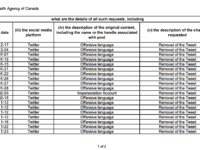
The risks associated with the government’s online harms (or online safety) plans is not limited to Canadian Heritage’s credibility gap, which as I’ve recounted has included omitting key information in its public reports on consultations and shocking efforts to exclude contrary voices altogether. A new report, based on the government’s response to a Parliamentary Written Question from Conservative MP Dean Allison (Sessional Paper No. 8555-441-1219) raises new concerns about efforts to censor social media. The written question asked the government for “requests made by the government to social media companies to take down, edit, ban or change in any other way social media content, posts or accounts since January 1, 2020.”
The resulting report is stunning as government departments have in fact pressured the social media companies to remove news links and a range of lawful content including tweets that are said to contain “offensive language” or an “offensive reply.” The use of government power to censor social media posts or news links is exceptionally dangerous and crystallizes the fears of regulatory powers without the necessary due process and oversight that could lead to censorship of lawful content online.

The Law Bytes Podcast, Episode 92: A Conversation with Senator Paula Simons on Copyright, the Internet and the Future of Media in Canada
Earlier this year, Senator Claude Carignan introduced Bill S-225, a bill that purports to address concerns about the viability of the Canadian media sector by amending the Copyright Act. The Senate has been studying the bill in recent weeks with Senator Paula Simons serving as the bill critic and one of the leads on the issue. Senator Simons was a longtime journalist before being appointed to the Senate and while an ardent supporter of local journalism, she has been critical of the proposed legislation. She joins the Law Bytes podcast to discuss the state of journalism in Canada, why she doesn’t think the social media companies “stole” stories from the media, and what Canada should be doing to encourage innovation in the media sector.

The Broadcasting Act Blunder, Day 5: The Narrow Exclusion of User Generated Content Services
The Broadcasting Act Blunder series has focused for the past two days on inaccurate claims from Canadian Heritage Minister Steven Guilbeault that the bill contains significant economic thresholds as a guardrail against over-regulation and excludes news from its ambit. As I noted, the bill does no such thing, though the CRTC will be able to establish regulatory exemptions once it conducts extensive hearings on implementing the legislation should it pass (prior posts in the Broadcasting Act Blunder series include Day 1: Why there is no Canadian Content Crisis, Day 2: What the Government Doesn’t Say About Creating a “Level Playing Field”, Day 3: Minister Guilbeault Says Bill C-10 Contains Economic Thresholds That Limit Internet Regulation. It Doesn’t, Day 4: Why Many News Sites are Captured by Bill C-10).
One type of service that is narrowly exempted from the new regulation in Bill C-10 is user generated content services, referred to in the bill as social media services. The bill states:

The Law Bytes Podcast, Episode 68: Mike Pal on What the Canadian Experience Teaches About the Intersection Between Election Law and the Internet
The world will be focused on the United States this week as the U.S. Presidential election is slated to take place on Tuesday, November 3rd. The role of social media has been in the spotlight in the US for months with calls for regulation, a range of responses from the major companies, and ongoing concerns about the immediate aftermath of the election and fears that their platforms could be weaponized if the winner is in dispute.
Canada had its own national election one year ago and enacted a range of reforms designed to address some of these issues. Mike Pal is a colleague at the University of Ottawa where he specializes in election law. He joins the Law Bytes podcast to discuss the Canadian experience including what changes were made, whether they were effective, what more can be done, and what Canada might teach others about confronting the challenges that lie at the intersection between elections and the Internet.
Recent Posts
 The Law Bytes Podcast, Episode 281: Mikolaj Barczentewicz on Europe’s Digital Sovereignty Push, CADA, and the Implications for Canada
 Ofcom Did the Work Canada Plans to Skip: What the UK’s Age Verification Report Reveals About the Bill C-34 Social Media Ban
 The Age Verification Bill That Won’t Die: How Bill S-209 Complicates the Government’s Bill C-34 Online Safety Plan
 The Law Bytes Podcast, Episode 280: A Fall Update on Where Things Stand on Canadian Digital Policy Reforms
 The Wrong Ban: The Heritage Committee Backed a Targeted Ad Ban for Kids and Stopped Short of a Social Media Ban, Yet the Government Chose the Reverse
