
The Delhi High Court has released what may be one of the most consequential copyright decisions yet on artificial intelligence, ruling in ANI Media Pvt. Ltd. v. OpenAI that OpenAI’s use of copyrighted news articles to train the models behind ChatGPT is prima facie fair dealing. The 135-page decision of Justice Amit Bansal, released last week, dismissed an Indian news agency’s application for an interim injunction, and while it is expressly not a final ruling on the merits, it features valuable analysis of the copyright implications of machine research, market harm and the public interest. The case is particularly notable from a Canadian perspective since it is the 2004 landmark CCH Supreme Court of Canada copyright case that provides the decision’s fair dealing foundation.
Post Tagged with: "copyright"
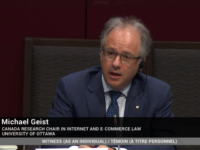
Addressing the AI Policy Challenge: My Appearance before the Standing Senate Committee on Transport and Communications
Earlier this week, I appeared before the Standing Senate Committee on Transport and Communications as part of its study on AI regulation. This follows earlier appearances before the House of Commons Heritage and Industry committees on the same issue. The hearing led to robust exchanges with multiple Senators on the intersection of AI policy with issues such as privacy, copyright, online harms, and sovereignty. I plan to post clips from the hearing in a future Law Bytes podcast, but in the meantime, my opening statement provides a good sense of my views on AI regulation with respect to privacy, copyright, and the need for an AI Transparency Act. A video of the opening statement is embedded below, followed by the text.

Win, Lose or Draw?: The Federal Court of Appeal Overrules a Key Copyright Case on Procedural Grounds
Nearly two years ago, I wrote that the Federal Court had issued a major decision on the relationship between fair dealing and digital locks, concluding that copyright’s anti-circumvention rules do not trump user rights (podcast on the case here). That decision, Blacklock’s Reporter v. Attorney General of Canada, was a big win for user rights because, for the first time, a court ruled that Canada’s anti-circumvention rules (aka digital lock rules) were subject to fair dealing. Last month, the Federal Court of Appeal set aside that judgment, ruling that the declarations in the lower court decision should never have been issued in the first place because they lacked “practical utility.” In basic terms, the case was “moot” since Blacklock’s had tried to withdraw the lawsuit and did not require a ruling. But while rights holders seem ready to celebrate, the reality is that the new ruling does not say the Federal Court was wrong on any of the substantive copyright questions.

The Law Bytes Podcast, Episode 253: Guy Rub on the Unconvincing Case for a New Canadian Artists’ Resale Right
The creation of an Artists’ Resale Right has been adopted in many countries to at best mixed reviews. They’re unsurprisingly widely supported by potential beneficiaries, but the data on who actually benefits raises real questions about the wisdom of the policy. Canada may be headed in the same policy direction as the government recently announced in its budget plans to introduce the measure. Professor Guy Rub is the Vincent J. Marella Professor of Law at Temple University’s Beasley School of Law and an expert in the intersection between intellectual property law, commercial law, the arts, and economic theory. Professor Rub has written critically about the Artists’ Resale Right including as part of a submission to a House of Commons committee that studied the issue several years ago. He joins the Law Bytes podcast to discuss the policy measure and its drawbacks, including his view that it primarily benefits artists who are wealthy, old, or dead.
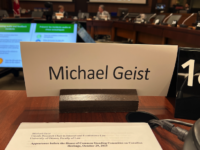
We Need More Canada in the Training Data: My Appearance Before the Standing Committee on Canadian Heritage on AI and the Creative Sector
The government, led by AI Minister Evan Solomon, is currently conducting a short consultation on AI regulation that has attracted criticism for its short time frame. At the same time however, the Standing Committee on Canadian Heritage has been working through a study on AI and the creative sector that may be more limited in scope, but has featured a broader range of perspectives. I had the opportunity to appear before the committee yesterday where I lamented that too often debates on new technology is framed “as a threat, emphasizes cross-industry subsidies, and misses the opportunities new technology presents. We therefore need risk analysis that rejects entrenching the status quo and instead assesses the risks of both the technology and the policy response. I’ll post the full discussion (which ventured into AI transparency, copyright, the news sector, and much more) in a future Law Bytes podcast episode. In the meantime, my opening statement is embedded and posted below.

Recent Posts
 The What, Me Worry? Consultation: Media Quietly Tells Government It Wants Even More Funding With Little Concern for Independence Risks
  Years of Uncertainty: Bill C-22’s Missing Regulations and Secret Ministerial Orders
  The Missing Charter Statement: Why Hasn’t the Government Explained How Bill C-34’s Social Media Ban Complies with the Charter?
  Three Years After October 7th: Living With the Shockwaves
  What If the U.S. Demanded This? The Cloud Provider Conditions Behind Canada’s EU Digital Pivot
