
The government is releasing its draft regulations for Bill C-18 today and the chances that both Google and Meta will stop linking to news in Canada just increased significantly. In fact, with the government setting an astonishing floor of 4% of revenues for linking to news, the global implications could run into the billions for Google alone. No country in the world has come close to setting this standard and the question the Internet companies will face is whether they are comfortable with the global liability that would see many other countries making similar demands. The implications are therefore pretty clear: there is little likelihood that Meta will restore news links in Canada and Google is more likely to follow the same path as the Canadian government establishes what amounts to 4% link tax from Bill C-18 on top of a 3% digital services tax and millions in Bill C-11 payments.
Post Tagged with: "google"

What Urgency?: CRTC Says It Will Take Years For Bill C-18 Media Bargaining to Begin
The Bill C-18 legislative process was marked by repeated warnings from the government that this was an urgent issue that justified its repeated efforts to cut off debate in order to fast track the bill into law before the summer break. In fact, in a late change, the bill was amended to provide that it would take effect with 180 days of royal assent, rather than the previously envisioned staged approach that would have resulted in a gradual development of regulations and implementation. That change has had enormous implications as the law can now take effect at any time but no later than December 19, 2023, which in turn led Meta to move to comply with the law immediately by blocking news links in Canada.
Notwithstanding the government’s plans, the CRTC apparently has other ideas.

Backdown or Bailout?: What Comes Next for the Government’s Epic Bill C-18 Miscalculation
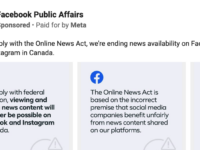
Meta’s announcement this week that it has started to block news links in Canada on both Facebook and Instagram due to Bill C-18’s mandated payments for links approach has sparked a flurry of commentary and coverage. News outlets such as Le Devoir have joined the Globe and Mail in expressing doubt about the government’s approach, news coverage has examined why the Meta ad boycott hasn’t taken off (hint: the government’s own party is still launching new ads) or why the Australian experience hasn’t been replicated in Canada (hint: different law, different time). Meanwhile, the political response has been discouraging with the government pretending to forget the Conservatives’ actual vote against Bill C-18 in the House of Commons, while the Conservatives insist on calling Bill C-18 a censorship bill when it isn’t. But perhaps the most interesting response is the speculation about what comes next. I don’t think anyone really knows, but this post offers a few possibilities.
What If It Isn’t a Bluff?!: The Consequences of the Government’s Epic Bill C-18 Miscalculation Begin to Set In
As Bill C-18 made its way through the legislative process, the government and the media lobby groups supporting the bill insisted that Google and Meta were bluffing when they warned that legislation premised on mandated payments for links could lead the companies to stop Canadian news linking or sharing on their platforms. Proponents would point to the Australian experience or claim that links to Canadian news were simply too valuable for the platforms to walk away. Compromise amendments were ignored in favour of tough talk about not backing down, the platforms were investigated for daring to test link blocking, and MPs and Senators acted as stenographers for media lobby groups by introducing amendments that now leave the government with even less flexibility in the regulatory process.
Over the past week, the reality appears to have begun to seep in.

Caving on Bill C-18: Government Outlines Planned Regulations that Signal Willingness to Cast Aside Core Principles of the Online News Act
Canadian Heritage Minister Pablo Rodriguez has insisted for months that Bill C-18, the Online News Act, is a market-based approach that would leave it to the Internet platforms and Canadian media outlets to negotiate deals based on the principle of mandated payments for links. Faced with the prospect of Meta and Google’s recent announcements that they would block news links in order to comply with the legislation, it would appear that the government has caved on the bill as it searches for a face-saving compromise. Rodriguez and Prime Minister Trudeau had tough talk last week, but behind the scenes they were seemingly ready to cast aside the core principles that they claimed were essential to the legislation.

Recent Posts
 When Writing About Antisemitism Proves the Point: What the Replies Reveal
  Acting on Antisemitism: If This Was Always Possible, Why Didn’t It Happen Sooner?
  Setting Canada’s AI Policy Priorities: My Appearance Before the Standing Committee on Industry, Science and Technology
  The Law Bytes Podcast, Episode 262: Zack Shapiro on the Claude AI Native Law Firm
  The Online Streaming Act in Jeopardy: U.S. Takes Aim at the CUSMA Cultural Exemption With Threats of Bill C-11 Retaliation
