
Bill C-34’s proposed social media ban for kids has rightly attracted considerable criticism since the bill was tabled last month, given that it requires age verification for most Canadians to use social media and the government plans to implement it before privacy safeguards are in place. Moreover, as I wrote last week, mounting data from Australia indicates that bans simply do not work. Thanks to a reader for pointing to a new Australian study that identifies yet another cost: young people’s access to news. The concern has resonance in Canada, where youth access to news on social media has already been undermined by the Online News Act, which prompted Meta to block news links on Facebook and Instagram. Bill C-34 would exacerbate the problem by cutting kids off TikTok and YouTube, which emerged as important news sources after the Meta news link block.
Post Tagged with: "social media ban"

The Data on Australia’s Social Media Ban: The Better the Privacy Protection, The Less Effective the Ban
As regular readers know, the Canadian plan to establish a social media ban for under 16s in Bill C-34 is based largely on the Australian model that took effect last December. With more data on the ban’s effectiveness continuing to roll in, multiple studies now confirm that it simply hasn’t worked as the majority of under-age users still have access to social media accounts. Yet rather than treating that as a reason to reconsider the model, Australian Prime Minister Anthony Albanese told Parliament in late June that his government is working “as a priority” to strengthen the law. The failure highlights a troubling correlation: the better the privacy protection, the less effective the ban. In other words, since users will find ways to circumvent the ban, “strengthening” the law likely means less privacy and more surveillance.

Soft Ban or Hard Verification Requirement?: Why Bill C-34’s Social Media Ban Exemption Gets the Incentives Wrong and Comes Too Late to Matter
The debate over Bill C-34’s social media ban for those under sixteen has largely focused on the impact on users, including mandated age verification for millions, the privacy risks of verification technologies, and experience elsewhere suggesting the policy is ineffective. Defenders of the ban have characterized the Canadian approach as a “soft ban” that will allow social media companies to obtain exemptions provided they meet yet-to-be-determined safety standards. This approach is said to create incentives for companies to address safety concerns and qualify for the exemption. But a closer look at the bill reveals that the approach does not work, as even “safe” services will be required to implement age verification for tens of millions of users. By the time the Digital Safety Commission has figured anything out, the services will have verified most of the country and likely lost users in the process. This is true not only for services that require significant design changes, but even those services that today would be widely acknowledged to be safe for children.

The Law Bytes Podcast, Episode 273: Rebroadcast of the Globe and Mail’s The Decibel on Canada’s First Steps Towards a Social Media Ban
Bill C-34, the Safe Social Media Act, has quickly become a lightning rod for debate since its introduction earlier this month. The issue that invariably tops the list is the kids’ social media ban. Bill C-34, along with the recently introduced Bill C-36, will be covered from multiple angles in the weeks ahead. For the moment, I am pleased to rebroadcast a recent episode of the Globe and Mail’s The Decibel podcast. I was invited to appear on the program, where I was interviewed by Sherril Sutherland about Bill C-34, the ban, and online harms and safety more broadly. I am grateful to the Globe for granting permission to rebroadcast the episode on my podcast uncut, in its entirety.

The Commission: How Bill C-34 Creates an Internet Super-Regulator That Will Touch the Lives of Millions of Canadians
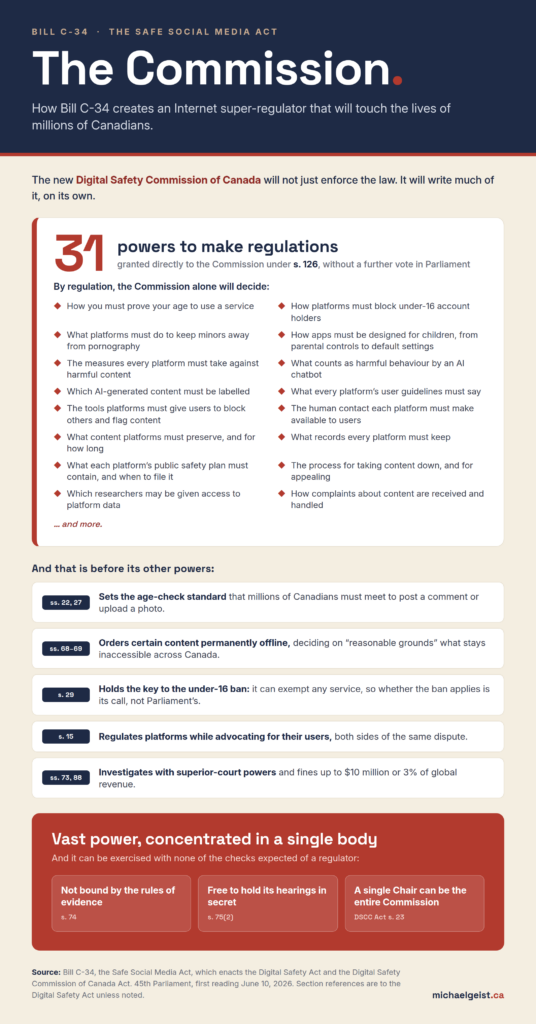
The proposed kids’ social media ban is capturing the headlines, but lost in the debate over Bill C-34 is that its most consequential element may be the creation and powers of the government agency the bill establishes to oversee the entire system. The Digital Safety Commission of Canada will be a super-regulator of the Internet, with greater influence over the daily lives of Canadians than perhaps any other regulator in the country. The breadth of its influence can’t be overstated: it will set the standards that millions of Canadians must satisfy to verify their age in order to use social media services. It will establish what platforms must do about harmful content, including the removal of certain material. It will determine whether the age-gating requirement may be lifted for any given service. It will both regulate the platforms and advocate for their users, dual roles that raise obvious fairness concerns. And it will exercise investigative and adjudicative powers, complete with penalties, hearings, and formal, law-enforcement-style investigations. Yet despite all those powers, it will not be bound by the rules of evidence, will be free to conduct its hearings in secret, and, at least in the beginning, will be capable of operating as a one-person body in which the Commission and its Chair are one and the same individual. The full scope of the new powers is illustrated in the infographic below.
Recent Posts
 Three Fixes for Lawful Access: Making the Case for Amending Bill C-22 at the Senate National Security Committee
 Jewish Students Are Telling the Same Story Everywhere But Only Canada Refuses To Listen
 What Happened to Competition? Why Sovereignty Is the Wrong Answer to Quebecor’s Bid for Telus
 The Law Bytes Podcast, Episode 283: Sabine Witting on Why the French Constitutional Council Struck Down France’s Under-15 Social Media Ban
 Back-of-the-Napkin Cultural Policy: The Government’s $600 Million Streaming Plan Copies the CRTC Decision It Killed at More Than Double the Cost
