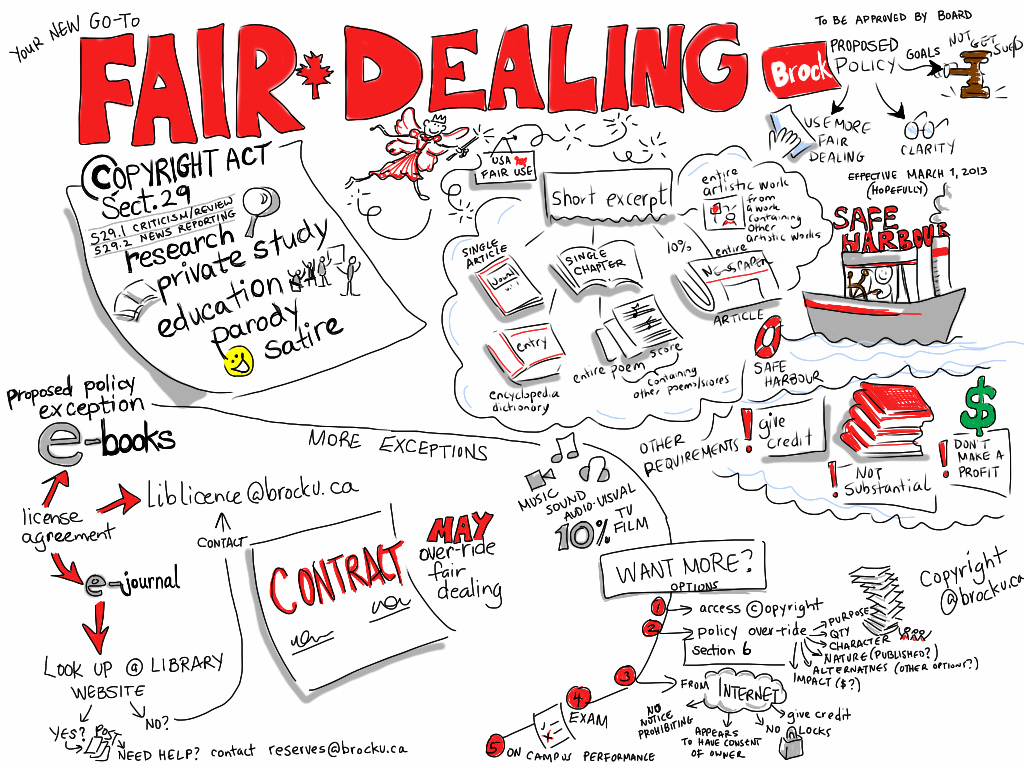
Fair Dealing by Giulia Forsythe (CC BY-NC-SA 2.0) https://flic.kr/p/dRkXwP
Copyright

From CCH to ChatGPT: How Canadian Copyright Law Played the Key Role in Deciding a Leading AI Training Data Case in India
The Delhi High Court has released what may be one of the most consequential copyright decisions yet on artificial intelligence, ruling in ANI Media Pvt. Ltd. v. OpenAI that OpenAI’s use of copyrighted news articles to train the models behind ChatGPT is prima facie fair dealing. The 135-page decision of Justice Amit Bansal, released last week, dismissed an Indian news agency’s application for an interim injunction, and while it is expressly not a final ruling on the merits, it features valuable analysis of the copyright implications of machine research, market harm and the public interest. The case is particularly notable from a Canadian perspective since it is the 2004 landmark CCH Supreme Court of Canada copyright case that provides the decision’s fair dealing foundation.

Starting Over: Court Filing Confirms the CRTC’s Streamer Contribution Decisions Are Dead With a Full Online Streaming Act Reset to Come
When the government announced plans last month to kill the CRTC’s Online Streaming Act ruling, it left a critical question unanswered: was the target only the Commission’s decision to increase streamer contributions to 15 percent, or did the reversal extend to the original base contribution decision requiring foreign streamers to contribute five percent of their Canadian revenues? A new court filing confirms it is both. In a letter to the Federal Court of Appeal dated July 17, 2026, first reported by the Wire Report, Department of Justice Senior General Counsel Michael Morris advised the court that “the Government’s intention is to eliminate the base contribution requirement on streaming services and to provide government funding to replace those contributions.” The entire contribution framework the CRTC has built since 2024 is therefore dead, with taxpayers covering the costs while the government develops a replacement.

The Law Bytes Podcast, Episode 274: Mark Musselman on What Stakeholders Really Think About the Government’s Reversal of the CRTC Online Streaming Act Decision
Earlier this month, the government shocked the culture sector by announcing it was effectively reversing the CRTC decision that implemented the Online Streaming Act. Culture Minister Marc Miller tried to cushion the blow with a promise of $600 million in support for the audio and audiovisual sectors, but there was no escaping the anger from some over abandoning a policy that had been years in the making. Mark Musselman is a former entertainment lawyer, longtime Canadian movie producer, and the author of the excellent White Paper Black Coffee Substack. He returns to the Law Bytes podcast to discuss the reversal, the stakeholder reaction, and the challenges that lie ahead.

Improv Policy: The Government Doesn’t Know What To Do About Its Online Streaming Act Mess
Earlier this month, the government shocked the culture sector by announcing it was effectively reversing the CRTC decision that implemented the Online Streaming Act. Culture Minister Marc Miller tried to cushion the blow with a promise of $600 million in support for the audio and audiovisual sectors, but there was no escaping the anger from some over abandoning a policy that had been years in the making. Weeks later, it is still not clear what precisely the government intends to do. In fact, it is increasingly evident that there is no plan, with the government improvising on critical issues such as the implementation of the reversal, funding for news, and the eventual contribution requirements for Internet streamers.

From Levy to Liability: Why Canada Risks Facing Hundreds of Millions in Retaliatory Tariffs Due to the CRTC’s Online Streaming Act Ruling
The CRTC’s Online Streaming Act ruling, which triples the mandated payments for large Internet streaming services, has attracted widespread criticism given fears the approach could result in higher consumer fees and a trade backlash from the United States. Culture Minister Marc Miller’s response to the ruling was somewhat muted, saying the government was reviewing the changes and assessing their impact. The reluctance to take a stronger public position may stem from concerns about the ruling’s trade implications, as it appears to violate Canada’s trade obligations. The violation can be saved by invoking CUSMA’s cultural exemption, but that triggers the U.S. right to apply dollar-for-dollar retaliation. In other words, if the Online Streaming Act generates hundreds of millions in mandated expenditures, it will also spark matching tariffs targeting high-value Canadian economic sectors.

Recent Posts
 The Missing Charter Statement: Why Hasn’t the Government Explained How Bill C-34’s Social Media Ban Complies with the Charter?
  Three Years After October 7th: Living With the Shockwaves
  What If the U.S. Demanded This? The Cloud Provider Conditions Behind Canada’s EU Digital Pivot
  Ontario is Done Waiting for Universities to Act on Campus Antisemitism
  Is Compromise on Encryption Possible? Why Bill C-22’s “Minor Opening” Leaves the Central Question Unanswered
