
Telecom by yum9me (CC BY-NC-ND 2.0) https://flic.kr/p/53jSy4

Telecom by yum9me (CC BY-NC-ND 2.0) https://flic.kr/p/53jSy4

Telecom

Canadian Wireless Reality Check: Why Our Wireless Market is Still Woefully Uncompetitive

Canadian Wireless Reality Check: Why Our Wireless Market is Still Woefully Uncompetitive

In the aftermath of the CRTC’s hearing on a consumer wireless code and the government’s announcement of its plan for future spectrum auctions, a debate has raged over the competitiveness and health of the Canadian wireless market. Scotia Capital released a report last week titled “Canadian wireless myths and facts” that argued the Canadian market is healthy and that “it is time for the regulators to declare victory on the policies they adopted five years ago”. Meanwhile, Open Media issued a report titled Time for an Upgrade: Demanding Choice in Canada’s Cell Phone Market that places on the spotlight on many of the ongoing problems in the market, with a particular focus on consumer complaints. The report includes many recommendations for regulatory and policy reform.

The reality is that both the regulators and politicians have either expressly or impliedly acknowledged that the Canadian wireless market is uncompetitive. Last week, Industry Minister Christian Paradis promoted the government’s past moves on wireless competition, but admitted that “there is much more to do.” Meanwhile, the Competition Bureau told the CRTC in its submission on the wireless code of conduct that:

certain impediments continue to diminish the effect of competitive forces in this industry. First, certain industry practices have tended to impose costs on consumers who wish to avail themselves of competitive alternatives. Second, consumers are not always provided with sufficient information in an adequately clear manner to make informed purchase decisions.

This post seeks to extend the debate and respond to some of Scotia Capital’s claims. It identifies ten reasons why there is ample evidence that the Canadian wireless market remains woefully uncompetitive when compared with peer countries around the world with higher costs, price gouging, and restrictive terms.


Read more ›

March 10, 2013 93 comments News

Industry Minister Paradis Makes Foreign Telecom Companies An Offer They Will Likely Refuse

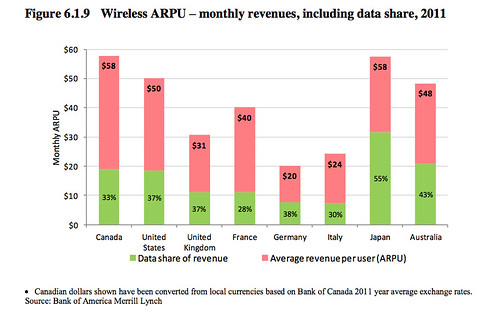
Industry Minister Christian Paradis was in the news this week (Globe, Post, Cartt.ca) urging foreign telecom companies to consider investing in the Canadian market in order to beef up the competitive environment. Paradis is right to court the big foreign players, who would bring capital, buying power that the current Canadian carriers can’t match (potentially leading to better deals on devices), and the ability to leverage their global networks to offer better roaming rates. Foreign telecom companies should view the Canadian market as attractive, given some of the highest ARPU (average revenue per user) rates in the world (see CRTC Figure 6.1.9). Yet they will likely give Canada a pass due in part to failed government policies. These include:

Read more ›

February 28, 2013 12 comments News

Internet Surveillance Bill is Dead but Canada’s Telecom Transparency Gap is Alive and Well

Appeared in the Toronto Star on February 23, 2013 as Canada’s Telecom Transparency Gap is Alive and Well The government’s recent decision to kill its online surveillance legislation marked a remarkable policy shift. The outcry over the plan to require Internet providers to install surveillance capabilities within their networks and […]

Read more ›

February 26, 2013 Comments are Disabled Columns Archive

Distributel Fights Back Against Motion to Disclose Subscriber Information in File Sharing Case

Distributel, an independent ISP with services in Quebec, Ontario, Alberta, and B.C., has fought back in a file sharing lawsuit launched by NGN Prima Productions, opposing a motion to disclose the names of subscribers alleged to have engaged in file sharing. It appears that NGN is using Canipre to identify alleged file sharers, the same company that has supplied information to Voltage Pictures in its case involving thousands of subscribers at TekSavvy. Distributel did not oppose a similar request in November 2012, but says in court documents filed today that several factors led to a change in position when NGN filed another request for more names.

First, Distributel was concerned with how NGN treated its subscribers, demanding a $1500 settlement in a notice claiming that subscribers could face up to $20,000 in damages. Distributel noted the lack of evidence for the claim made by NGN, relying on an expert analysis of BitTorrent to highlight the shortcomings. Moreover, Distributel says NGN is engaged in copyright trolling, citing the misrepresentation in the potential liability (the law now features a cap of $5,000 for non-commercial statutory damages) and the settlement demands that far exceed actual damages.

Read more ›

February 8, 2013 34 comments News

Competition Bureau to the CRTC on Wireless Code: Be Bolder

The Competition Bureau yesterday posted its submission to the CRTC on its draft wireless code.  The key message from the Bureau: be bolder. The Bureau expresses concern with the competitiveness of the wireless telecom sector in Canada:

certain impediments continue to diminish the effect of competitive forces in this industry. First, certain industry practices have tended to impose costs on consumers who wish to avail themselves of competitive alternatives. Second, consumers are not always provided with sufficient information in an adequately clear manner to make informed purchase decisions. These features can deprive consumers, competitors, and the Canadian economy of the beneficial effects of competition in this industry, namely lower prices, higher quality service, and greater innovation. This submission provides recommendations on how the Wireless Code can minimize the effect of these impediments.

Read more ›

February 7, 2013 3 comments News