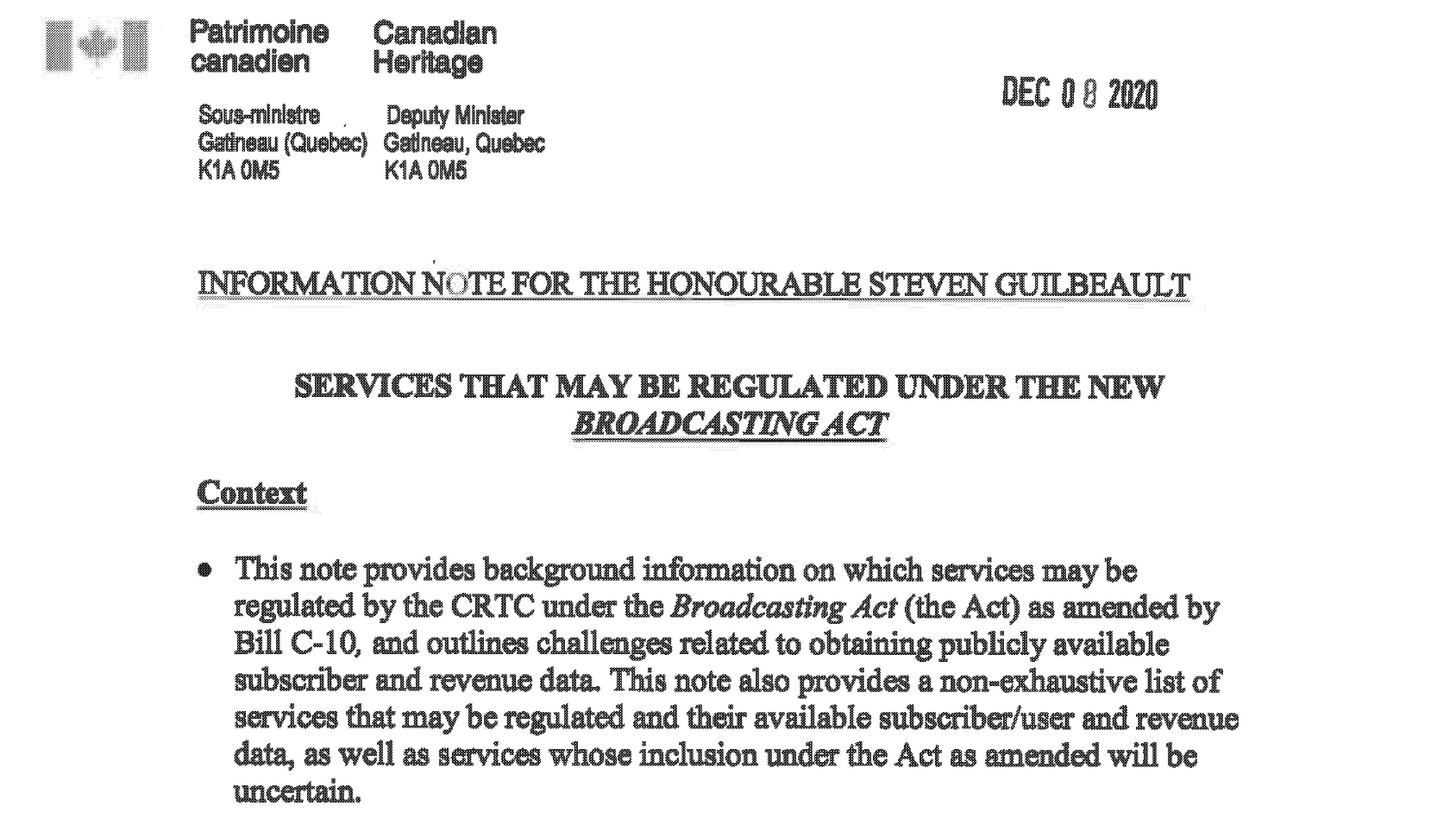
Canadian Heritage Memorandum, December 8, 2020, ATIP A-2020-00498
Bill C-10

From Levy to Liability: Why Canada Risks Facing Hundreds of Millions in Retaliatory Tariffs Due to the CRTC’s Online Streaming Act Ruling
The CRTC’s Online Streaming Act ruling, which triples the mandated payments for large Internet streaming services, has attracted widespread criticism given fears the approach could result in higher consumer fees and a trade backlash from the United States. Culture Minister Marc Miller’s response to the ruling was somewhat muted, saying the government was reviewing the changes and assessing their impact. The reluctance to take a stronger public position may stem from concerns about the ruling’s trade implications, as it appears to violate Canada’s trade obligations. The violation can be saved by invoking CUSMA’s cultural exemption, but that triggers the U.S. right to apply dollar-for-dollar retaliation. In other words, if the Online Streaming Act generates hundreds of millions in mandated expenditures, it will also spark matching tariffs targeting high-value Canadian economic sectors.

The Online Streaming Act Bill Comes Due: Why the CRTC’s Latest Ruling Guarantees Years of Trade and Legal Battles
The CRTC yesterday released its much-anticipated Online Streaming Act decision that has been years in the making. Given the likely opposition from many stakeholders, it is virtually certain to lead to protracted trade and legal battles. From the moment the government introduced Bill C-10 in 2020, its goal was to impose regulatory obligations on Internet streaming services, treating them as online broadcasters and mandating that they pay into the Canadian system. This week’s ruling puts a number on the payments, building on an earlier 5% interim levy with an additional 10% in expenditure requirements. The combined 15% places Canada among the most expensive operating jurisdictions in the world for streaming services, with consequences that will undoubtedly affect consumer streaming prices. Moreover, with the streaming services already challenging the interim 5% levy in court, they will undoubtedly challenge this one as well. In fact, the battle will not be limited to Canadian litigation. The U.S. government, which has become increasingly vocal in its opposition to the Online Streaming Act, will view this decision as a provocation and escalate pressure on Canada to drop the legislation altogether. Culture Minister Marc Miller appeared to hedge in his reaction to the decision, suggesting that the government sees the headaches that lie ahead.

The Online Streaming Act in Jeopardy: U.S. Takes Aim at the CUSMA Cultural Exemption With Threats of Bill C-11 Retaliation
From the moment it was first introduced as Bill C-10 in the fall of 2020, it was readily apparent that mandated payments by foreign streaming services to support Canadian content would face a trade backlash with the U.S., with the real prospect of trade retaliation. In fact, I wrote about the issue days after the bill was tabled, warning that an uneven playing field for benefits – foreign companies required to contribute but banned from benefiting – was a risky approach. Those warnings were dismissed by the government, cultural lobby groups, and supporters of the bill who assured critics that Canada’s cultural exemption under CUSMA provided a shield against U.S. retaliation.
It took years for Bill C-10 – later Bill C-11 – to become law as the Online Streaming Act, but now the bill has come due. Weeks after the U.S. Trade Representative (USTR) specifically identified Canadian digital laws as a target in CUSMA renegotiations, House Republicans introduced the Protecting American Streaming and Innovation Act, a bill that would mandate an investigation into the Canadian law and open the door not only to trade retaliation but also to a change in how the cultural exemption is applied.

Bill C-11’s Foundational Faults, Part Two: The Regulate-It-All Approach of Treating All Audio-Visual Content as a “Program”
My first post in a series on foundational faults in Bill C-11 focused on the virtually limitless reach of the CRTC’s jurisdictional power over audio-visual services. The starting point in the bill is that all audio-visual services anywhere in the world with some Canadian users or subscribers are subject to the Canadian jurisdiction and it will fall to the Commission to establish thresholds exempting some services from regulation. However, even with some exemptions, the Canadian approach will require registration and data disclosures, likely leading many services to block Canada altogether, reducing choice and increasing consumer cost.
The expansive approach in Bill C-11 isn’t limited to its jurisdictional reach, however. Not only does the law have few limits with respect to which services are regulated, it is similarly over-broad with respect to what is regulated, featuring definitions that loop all audio-visual content into the law by treating all audio-visual content as a “program” subject to potential regulation.

Lobby Harder: Canadian Heritage Minister Pablo Rodriguez Issues Industry Call to Action to Support Bill C-11
Canadian Heritage Minister Pablo Rodriguez appeared at the CMPA’s Prime Time conference last week, calling on the film, TV and broadcast sectors to become even more vocal in defending his Bill C-11. The bill, which has been the top lobbying priority of the sector for years, opens the door to regulating user generated content and asserts jurisdiction over all audio-visual services worldwide. There are several elements worth noting in the question-and-answer session with Rodriguez, not the least of which is the insistence on inaccurately claiming the new bill addresses concerns with regulating user generated content. When asked about the issue, Rodriguez responded:

Recent Posts
 The Missing Charter Statement: Why Hasn’t the Government Explained How Bill C-34’s Social Media Ban Complies with the Charter?
  Three Years After October 7th: Living With the Shockwaves
  What If the U.S. Demanded This? The Cloud Provider Conditions Behind Canada’s EU Digital Pivot
  Ontario is Done Waiting for Universities to Act on Campus Antisemitism
  Is Compromise on Encryption Possible? Why Bill C-22’s “Minor Opening” Leaves the Central Question Unanswered
